




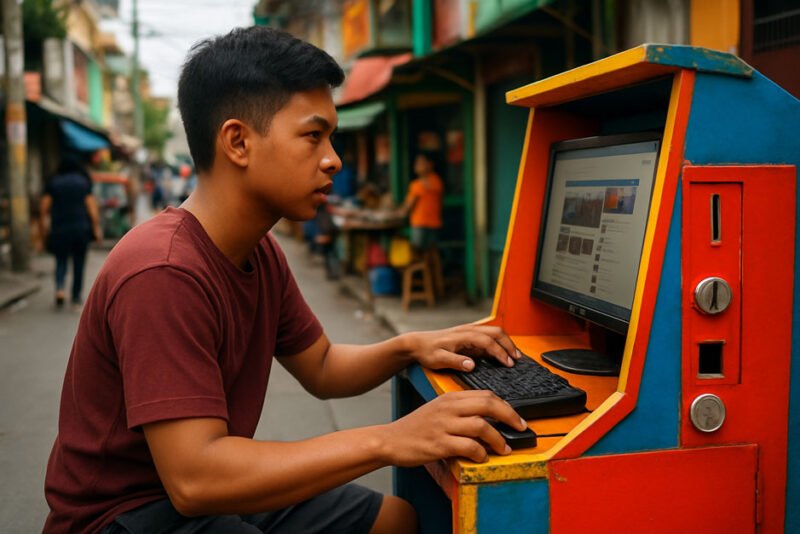
A Peso for the World Wide Web
Have you ever considered what it takes to bring the vastness of the internet to every corner of a developing nation, especially when traditional broadband is out of reach for the average citizen?
This challenge was ingeniously solved in the Philippines by a phenomenon known as Pasonet. It is a unique, coin-operated system that transformed the digital landscape, making online access a matter of just a few pesos.
More than just a machine, Pasonet represents a powerful example of grassroots innovation and entrepreneurial spirit that bridged a significant digital divide.
What Exactly is Pasonet (or Pisonet)?
At its core, Pasonet—often colloquially spelled and pronounced as Pisonet—is a self-service computer terminal designed for public use. The name itself is a portmanteau of the Filipino word for one peso, “piso,” and “internet.”
These kiosks are typically housed in small, custom-built wooden or metal cabinets, often seen lining busy streets, outside sari-sari stores, or even inside residential homes. They offer a full computer experience, complete with a monitor, keyboard, and mouse.
The entire setup is controlled by a simple, yet effective, coin-slot mechanism that dictates the user’s time online.
The Simple Mechanics of Coin-Op Internet
The genius of the Pasonet system lies in its straightforward, pay-as-you-go model. Users insert a coin, usually a one-peso coin, into a slot attached to the computer unit.
Upon insertion, a digital timer starts, granting the user a fixed amount of time, typically between four to six minutes, depending on the operator’s rate. When the time is about to expire, a warning flashes on the screen, prompting the user to insert another coin to continue their session.
This system effectively monetized internet access in micro-transactions, making it highly accessible and affordable for those who could not commit to monthly internet subscriptions or pay the higher hourly rates of traditional internet cafes.
Bridging the Digital Divide, One Coin at a Time
The most profound impact of the Pasonet phenomenon was its role in democratizing internet access across the archipelago. For millions of Filipinos, particularly those in low-income urban and rural areas, Pasonet was their first, and often only, gateway to the digital world.
It eliminated the need for expensive personal computers and costly home broadband installations. Instead, the internet became a commodity that could be purchased in small, manageable increments.
This affordability was crucial, allowing students to conduct research, job seekers to send applications, and families to connect with relatives working abroad. It was a true equalizer in the burgeoning digital economy.
More Than Just Browsing: Pasonet’s Cultural Footprint
Pasonet booths quickly evolved into more than just internet access points; they became vital social and cultural hubs. They fostered a unique form of community, especially among the youth.
For many, the kiosks were the primary venue for online gaming, with popular titles like Dota and CrossFire dominating the screens. Friends would gather around the small cubicles, sharing strategies and celebrating victories in a shared digital space.
Beyond gaming, Pasonet facilitated the country’s rapid adoption of social media platforms. It allowed a generation to participate in global conversations, shaping Filipino online culture and communication habits.
The Business Model: A Micro-Entrepreneurial Success
The rise of Pasonet also sparked a wave of micro-entrepreneurship. The cost of setting up a Pasonet unit was relatively low, making it an attractive small business venture for local families.
Operators could easily convert a small space in their home or shop into a Pasonet station, generating a steady stream of passive income. This decentralized business model allowed the service to penetrate deep into neighborhoods that larger corporations would overlook.
It is a testament to Filipino ingenuity, transforming a simple technological need into a sustainable, community-based economic opportunity.
Pasonet’s Enduring Legacy in a Fiber-Optic Age
While the landscape of internet connectivity in the Philippines has changed dramatically with the proliferation of mobile data and fiber-optic broadband, Pasonet has not entirely disappeared.
Today, its presence is less dominant, but the kiosks remain a fixture in many provincial areas and low-income communities where high-speed internet remains a luxury. Pasonet’s legacy is not just in the hardware, but in the cultural memory of a generation.
It stands as a powerful symbol of how necessity breeds innovation, and how a simple, coin-operated machine served as the essential bridge that brought millions of Filipinos into the global digital age.
Frequently Asked Questions About Pasonet
Q: Is it Pasonet or Pisonet?
A: Both terms are widely used, but Pisonet is the more common and colloquial spelling in the Philippines. It is derived from “piso” (peso) and “internet.” Pasonet is often used in a more formal or generalized context.
Q: How much did Pasonet cost to use?
A: The standard rate was typically one peso (₱1.00) for a fixed duration of time, usually between four to six minutes. This rate could vary slightly depending on the location and the operator.
Q: Is Pasonet still widely used today?
A: While its popularity has declined due to cheaper mobile data and wider broadband availability, Pasonet kiosks are still operational in many parts of the Philippines, especially in areas with limited access to modern internet infrastructure.
Q: Is Pasonet legal in the Philippines?
A: The operation of Pisonet kiosks is generally considered legal, provided the operators comply with local business permits and licensing requirements, and ensure the software used is properly licensed.