




In business, security is often pictured as an abstract concept: firewalls, encryption, and cybersecurity protocols. While vital, this digital focus can obscure a more fundamental truth. Every digital safeguard is irrelevant if the physical barrier protecting your assets, employees, and data fails first. Your building’s perimeter forms the absolute foundation of any comprehensive security strategy. Reinforcing this boundary is not a reaction to threat; it is a proactive declaration of your commitment to safety, continuity, and peace of mind.
Rethinking the Perimeter as an Asset
A business’s external doors are more than points of entry and exit; they are critical control interfaces. Standard doors installed for basic weather and privacy functions offer minimal resistance to determined intrusion. Upgrading to engineered commercial security doors transforms these weak points into formidable, tested barriers. This approach moves security from an afterthought to a core structural asset, designed to deter, delay, and deny unauthorized access before any alarm is ever triggered.
The Anatomy of a True Security Door
What differentiates a security door from a sturdy one? It begins with the core materials. Heavy-gauge steel or reinforced aluminium alloys provide inherent strength. Multi-point locking systems engage the frame at several locations, not just at the latch, making forced entry exponentially more difficult. Certified hinges with non-removable pins prevent the entire door from being lifted off. These engineered components work in concert to create a unified shield far greater than the sum of its parts.
Integration with Access Control Systems
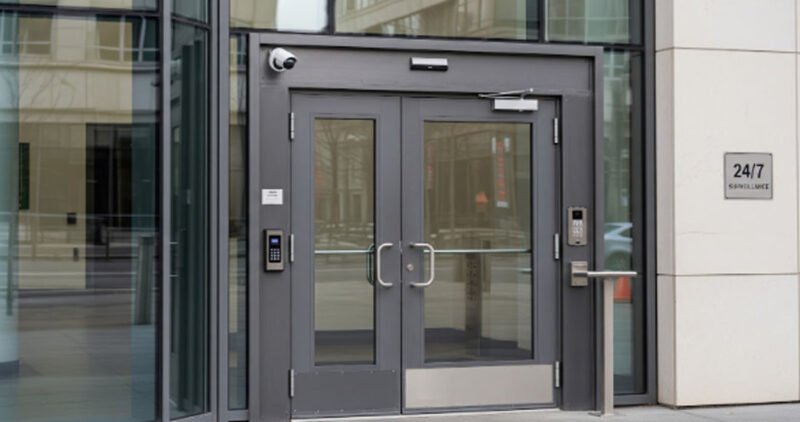
A robust physical barrier becomes intelligent when integrated with electronic access management. High-security doors are designed to seamlessly accommodate card readers, biometric scanners, or keypad systems. This integration allows you to control, monitor, and log every entry and exit. It ensures that the physical strength of the door is complemented by the precision of digital policy, restricting access to authorised personnel only and creating a detailed audit trail.
Mitigating Specific Threats
Different businesses face distinct risks. A retail outlet needs to prevent smash-and-grab attacks after hours. A data centre requires protection against more sophisticated, prolonged attempts at forced entry. A warehouse might prioritise resistance to vehicle impact. Specialist security doors are rated for specific threats, including manual attack tools, ballistic resistance, or even blast mitigation. Identifying your primary risk profile is essential for selecting a door with the appropriate certification and performance rating.
Beyond Security: Operational and Environmental Benefits
Investing in high-performance doors delivers advantages beyond pure protection. Their superior construction and sealing dramatically improve thermal insulation, reducing energy costs for heating and cooling. Acoustic dampening creates a quieter, more productive internal environment. Enhanced durability also means significantly lower long-term maintenance and replacement costs compared to standard commercial doors, offering a strong return on investment across multiple fronts.
Compliance and Insurance Implications
For many sectors, robust physical security is not optional—it’s mandated by industry regulations or insurance providers. Installing certified security doors can be a direct requirement for compliance with standards in finance, healthcare, or logistics. Furthermore, insurers often recognise professionally installed, rated security products, which can lead to reduced premiums by demonstrably lowering the risk profile of your premises.
The Importance of Professional Specification and Installation
The most secure door is only as effective as its installation. Professional specification ensures the selected model perfectly matches the threat level and architectural requirements of your opening. Expert fitting by certified technicians guarantees the door and frame perform as an impregnable unit, with no weak points introduced through poor alignment or inadequate fixing. This end-to-end service is critical for warranty validation and achieving the certified performance you paid for.
A Foundational Investment in Certainty
Ultimately, securing your perimeter with engineered doors is an investment in business certainty. It protects your most valuable assets: your people, your inventory, and your intellectual property. It fosters a culture of safety that boosts employee morale and confidence. It signals to clients and partners that you take protection seriously. In a world of complex risks, fortifying your first physical line of defense provides the solid foundation upon which all other security, both digital and procedural, can reliably stand.